

Silicon Metasurfaces Unlock Ultrafast Modulation of Wide-Bandwidth Optical Pulses
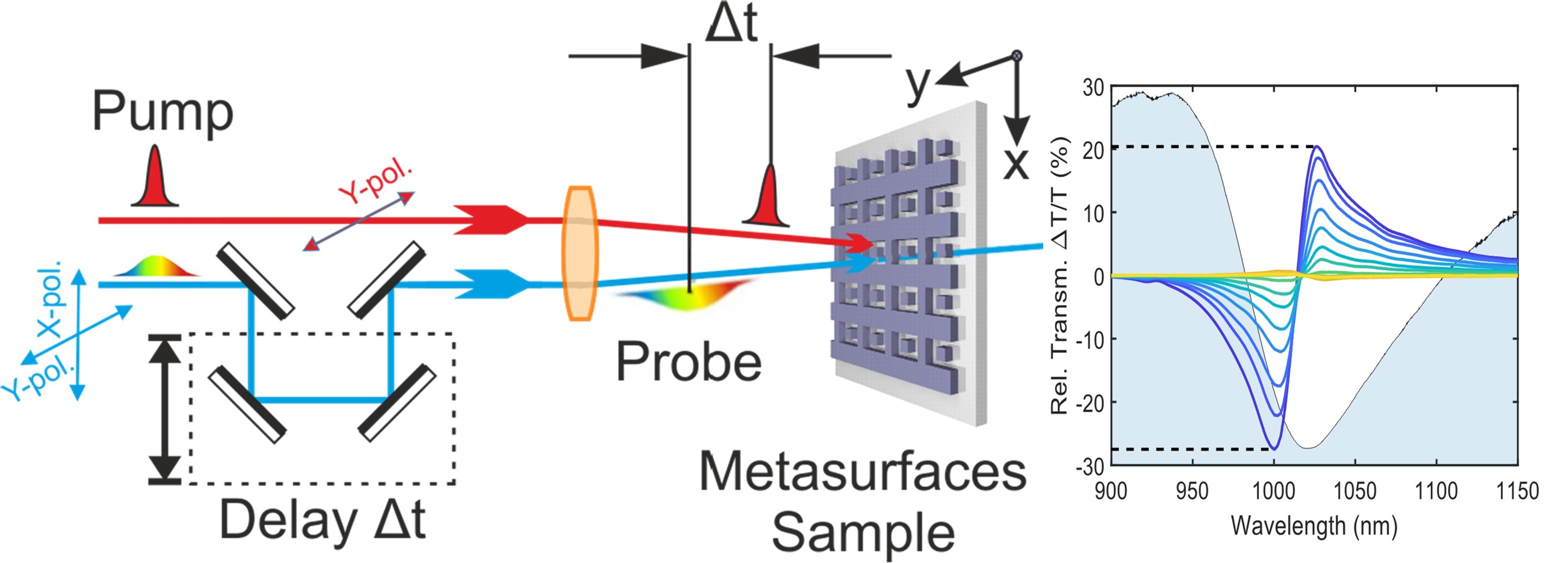
A schematic diagram of the experiment, where the pump excites the metasurface before the arrival of the probe pulse. This causes ultrafast modulation over a wide range of colours.
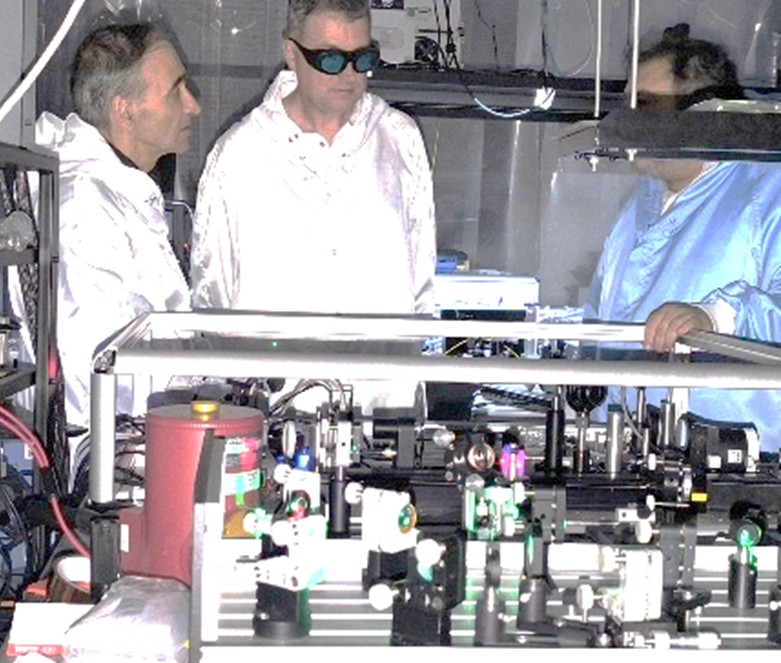
This international study united researchers from the Australian National University (Australia), Sofia University and the John Atanasoff Centre for Bio and Nano Photonics (Bulgaria), Politecnico di Milano (Italy), and Nottingham Trent University (UK). Sup
Breaking the bandwidth barrier in ultrafast all-optical modulation
CHENGDU, CHINA, August 5, 2026 /EINPresswire.com/ -- This research shows a new way to control light at extremely high speeds using ultra-thin silicon metasurfaces. By carefully designing how light passes through them, the team achieved strong and fast control over a wider range of colours than previously possible. This breakthrough helps overcome a key limitation in current technology and could support faster internet, improved data processing, and future light-based computing systems.First section: Controlling light is essential for many modern technologies, from high-speed internet to advanced computing systems. Traditionally, the intensity of light is controlled using interference-based devices, in which light waves overlap to create patterns of brighter and darker regions. While effective for single colours of light, these methods struggle when dealing with broadband light, which contains many different colours. In such cases, the light waves quickly lose their coordinated behaviour, making conventional techniques less effective. Existing alternatives, such as electro-optic switches, can handle broadband light but are often bulky, slow, and require complex electronics.
To address these challenges, researchers have turned to metasurfaces—ultra-thin layers made of tiny, carefully engineered structures that can control light with high precision. These structures interact with light in unique ways, allowing scientists to shape and direct it on a very small scale. The study was published in Opto-Electronic Advances on June 02, 2026. In addition, metasurfaces can respond to external stimuli, enabling active control of light. Among various approaches, using light itself to control light—known as all-optical modulation—is particularly attractive because it can operate extremely fast.
However, most metasurface-based approaches still face a limitation: they are only effective over a very narrow range of colours. This restriction has limited their usefulness for real-world applications involving broadband signals.
In this work, the researchers developed a new design strategy that overcomes this limitation. By carefully shaping how light is transmitted through a silicon-based metasurface, they created a response that enables strong, fast modulation across a much wider range of colours. Using ultrafast laser techniques, they demonstrated rapid switching of light signals on timescales of just trillionths of a second.
This advance provides a new pathway for compact, high-speed optical devices, with potential applications in faster data transmission, improved sensing, and future light-based computing systems.
Second section:
This research by the METAFAST collaboration represents an important step toward faster, more compact, and more energy-efficient methods for controlling light, with significant implications for a wide range of technologies. The ability to modulate light rapidly and across a broad range of colours is particularly valuable for applications such as Light Detection and Ranging (LiDAR), laser mode-locking and optical communications, where information is transmitted using rapidly modulated light signals. As global demand for data continues to grow, driven by video streaming, cloud computing, and artificial intelligence, there is a strong need for technologies that can process and transmit information faster and more efficiently. The metasurface-based approach demonstrated here offers a promising pathway to meet these demands.
Beyond communications, this technology could also play a role in future optical or “light-based” computing systems. Unlike conventional electronics, which rely on electrical currents, photonic systems use light to perform operations and can potentially operate at much higher speeds with lower energy consumption. The ability to control short, broadband light pulses with high precision is a key requirement for such systems. Compact metasurfaces, which can be integrated onto chips, make this vision more practical by reducing the size and complexity of optical components.
Looking ahead, the next steps for this research include further improving the efficiency and speed of modulation, reducing energy requirements, and integrating these metasurfaces into real-world photonic devices and systems. Researchers may also explore new materials and designs to further enhance performance.
In the long term, these findings suggest a shift toward more versatile and scalable optical technologies. By overcoming key limitations in how light is controlled, this work helps pave the way for future systems where light—not electricity—plays a central role in communication, computation, and information processing.
Reference
Title of original paper: Ultrafast all-optical modulation of wide-bandwidth pulses enabled by silicon-metasurfaces
Journal: Opto-Electronic Advances
DOI: https://doi.org/10.29026/oea.2026.260007
Funding information
This work was supported by the Australian Research Council under the Centre of Excellence for Transformative Meta-Optical Systems (TMOS) (CE200100010). The sample fabrication was supported by the Australian National Fabrication Facility (ACT node). This publication is part of the METAFAST project that received funding from the European Union Horizon 2020 Research and Innovation program under Grant Agreement No. 899673. GDV and UAL acknowledge the support from the HOTMETA project under the PRIN 2022 MUR programme funded by the European Union - Next Generation EU - "PNRR—M4C2, investimento 1.1 - "Fondo PRIN 2022"—HOT-carrier METasurfaces for Advanced photonics (HOTMETA), contract no. 2022LENW33—CUP: D53D2300229 0006". IB, LP, SG, and HI acknowledge support by the Ministry of Education and Science of Bulgaria (HEPHAESTUS grant) of the Bulgarian National Roadmap for Research Infrastructure. I.B. and A.T. acknowledge financial support by the European Union-NextGenerationEU, through the National Recovery and Resilience Plan of the Republic of Bulgaria, SUMMIT BG-RRP-2.004-0008-C0. MR and LX acknowledge support from the UK Research and Innovation Future Leaders Fellowship (MR/Z000270/1).MR appreciates the support from ERC Consolidator Grant (UPIRI, 101170298).
Siyi Ma
Institute of Optics and Electronics, Chinese Academy of Scie
+86 191 3618 6296
oej_publishing@ioe.ac.cn
Legal Disclaimer:
EIN Presswire provides this news content "as is" without warranty of any kind. We do not accept any responsibility or liability for the accuracy, content, images, videos, licenses, completeness, legality, or reliability of the information contained in this article. If you have any complaints or copyright issues related to this article, kindly contact the author above.
