

Growing Energy Demand from Data Centres Driven by AI and Projected Electricity Consumption to Reach 945 TWh by 2030, Representing 3% of Global Electricity Consumption
According to data published by Precedence Research, the electricity consumption of data centres is set to grow rapidly, with a projected 945 TWh demand by 2030, contributing to 3% of global electricity usage. This growth is primarily fueled by accelerated server requirements for AI workloads. Major regions such as the United States and China will account for nearly 80% of global growth, while Southeast Asia is expected to experience significant expansion due to growing e-commerce and cloud services.
Ottawa, Feb. 10, 2026 (GLOBE NEWSWIRE) -- Energy demand from data centres is forecasted to rise sharply, with consumption reaching 945 TWh by 2030, driven by accelerated servers used for AI workloads, according to data published by Precedence Research. Key regions like the United States, China, and Europe will continue to dominate, while Southeast Asia will see significant growth, with consumption doubling by 2030. Sensitivity scenarios predict potential demand ranging from 700 TWh to 1,700 TWh by 2035.
As artificial intelligence (AI) continues to transform industries, its energy consumption, particularly in data centres, is becoming a significant factor in global electricity demand. Data centres house the computing infrastructure required to process vast amounts of data, including the hardware and software necessary to train and deploy AI models. This article explores how data centres are impacting the global energy system, their role in AI workloads, and the projected trends in energy consumption from these facilities.
Invest in Our Premium Strategic Solution: https://www.precedenceresearch.com/request-consultation/18
What is a Data Centre?
A data centre is a facility used to house servers, storage systems, networking equipment, and other components required to store and process data. It is essential for cloud computing services, AI processing, and various digital applications. Data centres are made up of the following components:
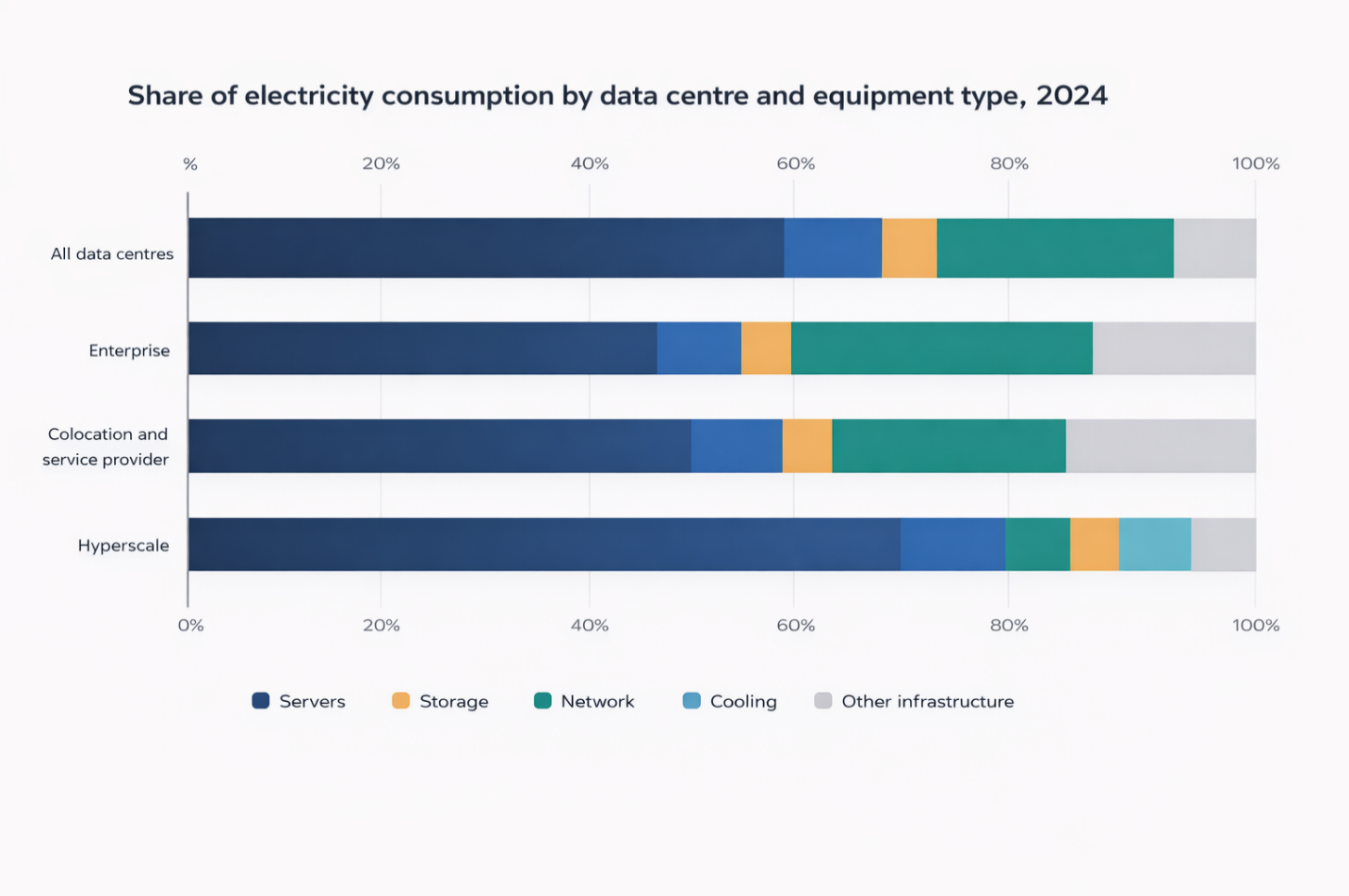
- Servers: These are powerful computers that process and store data. They are equipped with central processing units (CPUs) and often specialized accelerators like graphics processing units (GPUs), which are increasingly used for AI model training. Servers typically account for around 60% of electricity demand in data centres.
- Storage Systems: These devices store data centrally and are responsible for backup and retrieval. They account for about 5% of electricity consumption in data centres.
- Networking Equipment: This includes switches, routers, and load balancers, which manage the traffic between servers and devices. Networking equipment accounts for up to 5% of electricity demand.
- Cooling Systems: Data centres require cooling to maintain optimal operating conditions for IT equipment. The share of electricity consumed by cooling varies by data centre type, ranging from 7% in efficient hyperscale data centres to over 30% in less-efficient enterprise data centres.
-
Backup Power: This includes uninterruptible power supplies (UPS) and backup generators, which provide power during outages. While they are rarely used, they are crucial for ensuring high reliability.
These components work together to provide reliable, high-performance environments for data processing, but they also drive significant electricity consumption.
The Rising Energy Demand from Data Centres
The electricity consumption from data centres is projected to reach 415 terawatt hours (TWh) in 2024, making up approximately 1.5% of global electricity consumption. This consumption has been growing steadily, at an average annual rate of 12% over the past five years.
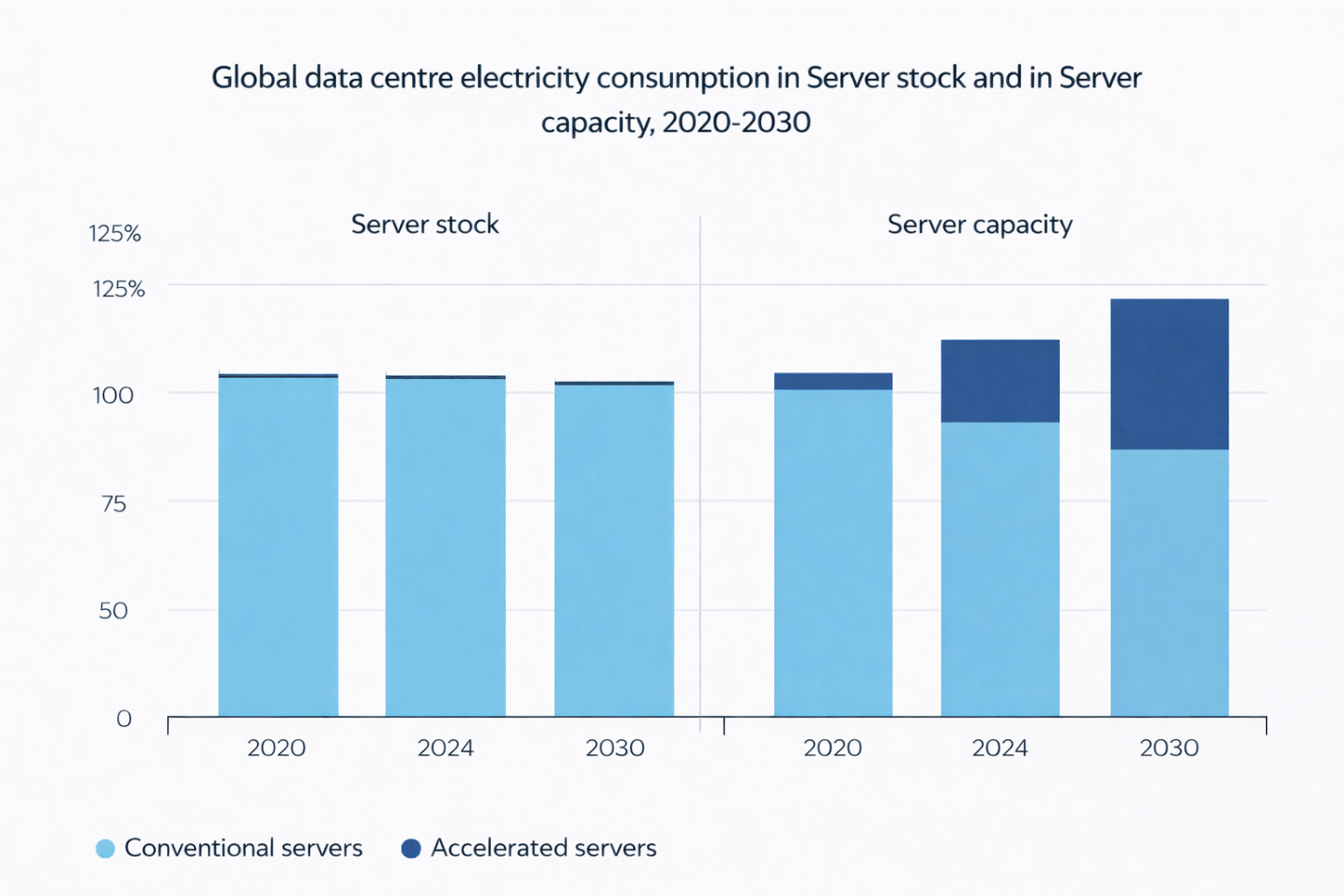
The rise of AI is accelerating the demand for high-performance accelerated servers, such as those equipped with GPUs and tensor processing units (TPUs), which have much higher power densities than conventional servers. AI workloads, in particular, require massive computational power, leading to greater energy demand in data centres.
Request Research Report Built Around Your Goals: sales@precedenceresearch.com
Projected Electricity Consumption by Data Centres (Base Case, 2020–2030)
| Year | Electricity Consumption (TWh) | Key Contributor |
| 2020 | 250 | Conventional servers |
| 2024 | 415 | Accelerated servers |
| 2030 | 945 | Accelerated servers |
In the Base Case scenario, global electricity consumption from data centres is projected to double by 2030, reaching around 945 TWh, which would represent just under 3% of total global electricity consumption by 2030.
Energy Demand Growth by Data Centre Type
The energy demand from different types of data centres varies based on their size, efficiency, and the equipment they house. The table below shows the share of electricity consumption by different types of equipment in data centres.
Key Insights:
- Hyperscale data centres, which are the largest and most efficient, have a lower cooling demand (~7%) due to advanced cooling technologies and better energy optimization.
- Enterprise data centres, which tend to be smaller and less efficient, consume a higher share of energy for cooling (~30%) and other infrastructure needs.
Regional Outlook and Energy Consumption
The demand for data centre electricity is not uniform across regions. The United States, China, and Europe remain the largest regions for data centre electricity demand, but other regions, such as Southeast Asia, are experiencing significant growth.
Projected Growth in Data Centre Electricity Consumption by Region (2020–2030)
| Region | 2020 Consumption (TWh) | 2030 Projected Growth (TWh) | Growth Percentage (%) |
| United States | 250 | 600 | +130 |
| China | 175 | 450 | +170 |
| Europe | 90 | 135 | +70 |
| Southeast Asia | 30 | 70 | +130 |
Key Insights:
- The United States and China will account for nearly 80% of global growth in data centre electricity consumption by 2030.
- Southeast Asia is expected to see significant growth, with consumption more than doubling by 2030, largely due to growing e-commerce and cloud services in the region.
Sensitivity Cases for Future Energy Demand
The future energy demand from data centres is subject to significant uncertainties, particularly regarding AI adoption, energy efficiency improvements, and the pace of data centre deployment. The Lift-Off, High Efficiency, and Headwinds cases explore different scenarios based on these factors.
Energy Demand Scenarios (2024–2035)
- Base Case: Data centre electricity demand reaches 945 TWh by 2030, representing 3% of global electricity consumption.
- Lift-Off Case: With faster AI adoption and more data centres, demand could exceed 1,700 TWh by 2035, accounting for 4.4% of global electricity demand.
- High Efficiency Case: Strong progress in energy efficiency in hardware, software, and infrastructure could reduce demand to around 970 TWh by 2035, representing 2.6% of global electricity demand.
- Headwinds Case: Slower than expected AI adoption and local bottlenecks in data centre deployment could limit demand to around 700 TWh by 2035, or less than 2% of global electricity demand.
As AI adoption accelerates, the energy demand from data centres is expected to continue growing rapidly, particularly from high-performance accelerated servers used for AI workloads. While the United States, China, and Europe will continue to dominate data centre electricity consumption, emerging regions such as Southeast Asia are also becoming key players in the global data centre landscape.
In the coming years, the pace of this growth will largely depend on advances in energy efficiency, the ability to manage AI energy demand, and the adoption of sustainable technologies like renewable energy and energy-efficient cooling solutions. Data centres, though critical for the digital economy, will need to balance their energy needs with sustainable practices to minimize their environmental footprint and integrate effectively into the broader energy system.
Invest in Our Premium Strategic Solution: https://www.precedenceresearch.com/request-consultation/18
Request Research Report Built Around Your Goals: sales@precedenceresearch.com
About Us: Precedence Research
Our Legacy: Rooted in Research, Focused on the Future
Looking for research that drives real results? Precedence Research delivers strategic, actionable insights, not just data and charts. Based in Canada and India, our team specializes in customized market analysis, executive-level consulting, and tailored research solutions that go beyond traditional survey methodologies to support business growth with precision and confidence.
Insight-Driven
We turn complex data into clear, strategic insights that power confident business decisions.
Innovation-Led
We continuously refine our methods to stay ahead of trends and emerging market forces.
Industry-Agnostic
From tech to healthcare, we serve clients across sectors with tailored, actionable intelligence.
Customer-Centric, Future-Focused, Result-Oriented
We work as strategic partners, engaging deeply with clients to co-create impactful solutions.
Our Commitment: Delivering Intelligence That Drives Transformational Growth
What do we do? We turn data noise into clarity. Through sharp research, agile thinking, and tech-enabled tools, we fuel brands, disrupt markets, and lead with insight that drives unstoppable growth.
Contact Us
USA: +1 8044 419344
APAC: +61 4859 81310 or +91 87933 22019 or +6531051271
Europe: +44 7383 092 044
Email: sales@precedenceresearch.com


Legal Disclaimer:
EIN Presswire provides this news content "as is" without warranty of any kind. We do not accept any responsibility or liability for the accuracy, content, images, videos, licenses, completeness, legality, or reliability of the information contained in this article. If you have any complaints or copyright issues related to this article, kindly contact the author above.
